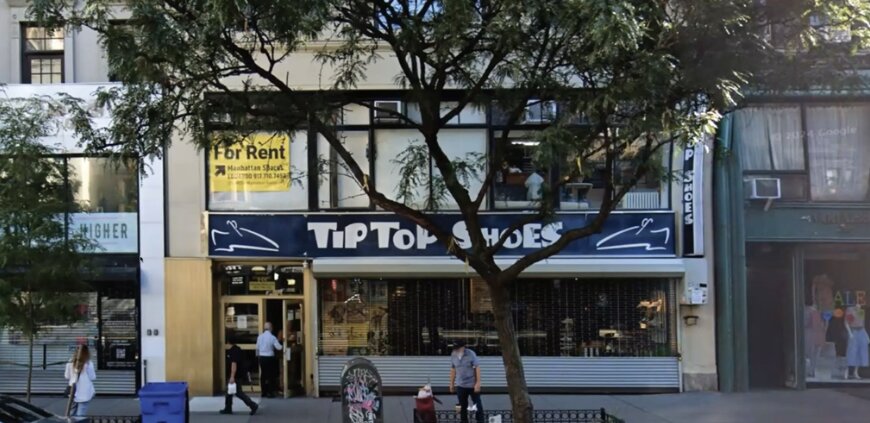
Tip Top Shoes today. Photo via Nash Design presentation to Community Board 7
Tip Top Shoes is replacing the sign over its storefront, and the new design is a deliberate throwback. Community Board 7’s Preservation Committee approved it unanimously on Thursday.
Advertisement
The shoe store, which the Wasserman family has run at 155 West 72nd Street since 1964, sits inside the Upper West Side/Central Park West Historic District, which is why a new sign needs sign-off at all. The vote was 5-0, and the committee’s recommendation now goes to the Landmarks Preservation Commission, which has the final say.The sign there now is flat vinyl, the kind that went up on storefronts across the city in the early 2000s, according to designer Alexander King of Nash Design, who presented the application alongside owner Lester Wasserman. King told the committee that those signs don’t hold up and don’t do the block any favors.
He said business owners around the city have been going back to the sign styles of the 1940s through the 1980s, back when signs were built by craftsmen rather than turned around quickly by a vinyl shop.
King said he started the project by digging through the store’s own archives. Tip Top has had three or four different signs since it opened in 1940, and the new design merges two of them. In the center, three-dimensional acrylic channel letters spell out Tip Top Shoes. Flanking them on either side are illuminated triangular panels, a direct callback to the store’s earliest sign, carrying illustrations of men’s and women’s shoes and the tagline the business has used for years: “Where your feet are in good hands.” The words “Since 1940” and the street address run along the edges in flat acrylic. The palette is Tip Top’s navy blue and white, with a brass finish outlining the letters and the casing.
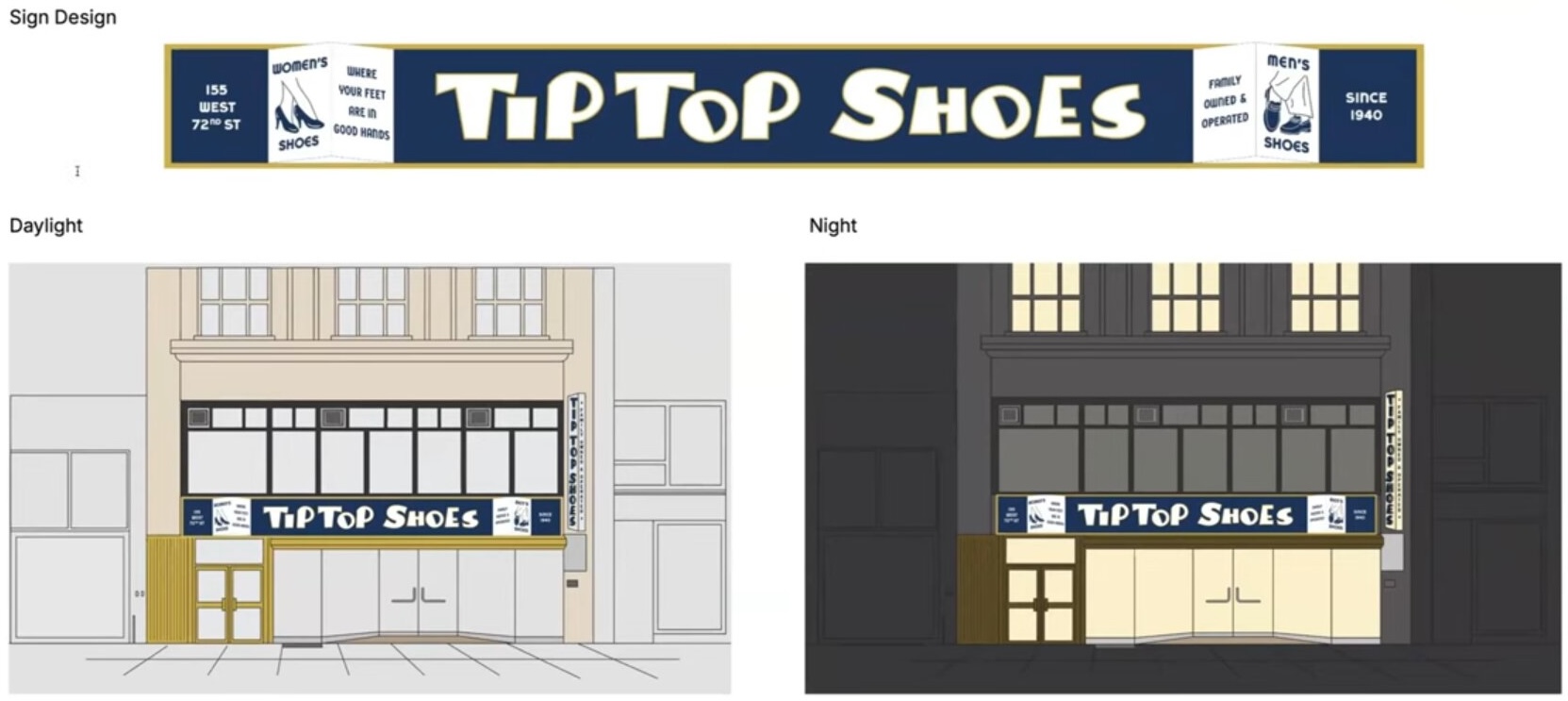
Renderings of the future sign c/o Nash Design
None of the type came out of a font file. “All the typography on this sign is hand done by me,” King told the committee, adding that he wanted the result to “really beautify 72nd Street.”
Advertisement
Among the archival images King showed was a photo of the storefront from the early 1970s. He guessed the man standing in it was Wasserman’s father. Wasserman corrected him. It was his grandfather, Max, who ran a small shoe store in the Bronx before the family bought Tip Top and moved to the neighborhood.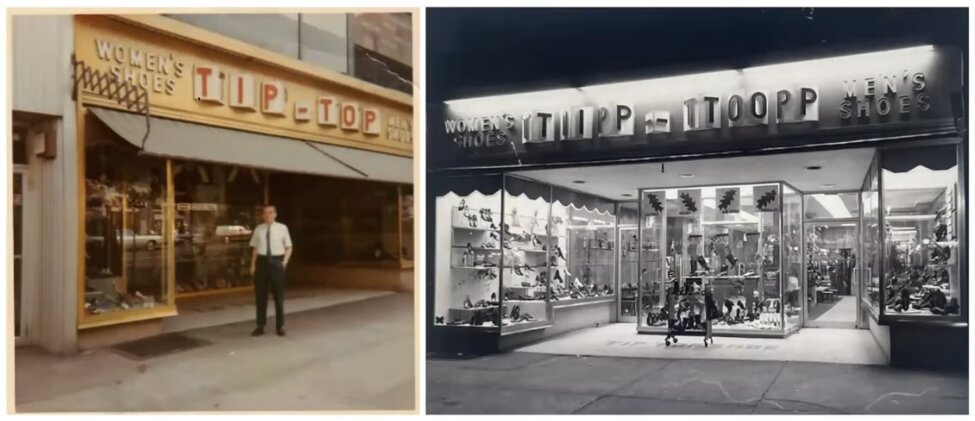
Tip Top Shoes in the early 1970s. Photo via Nash Design presentation to Community Board 7.
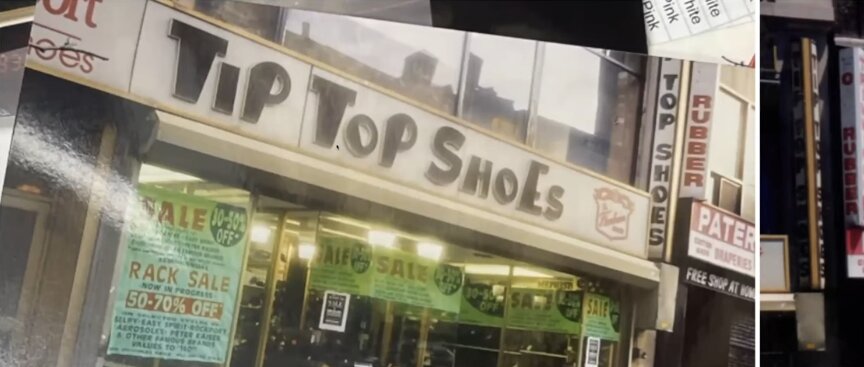
This design came later. Photo via Nash Design presentation to Community Board 7.
That era was a big one for the business. Tip Top started carrying Birkenstock in the early 1970s, when almost nobody on the East Coast was selling the brand, and Danny Wasserman advertised it in Rolling Stone and The New York Times Magazine with a tagline about ugly shoes that make you smile. Customers came in from New Jersey and upstate to buy them.
The vertical blade sign that hangs off the building isn’t part of the application. It’s being swapped out for the same thing that’s there now.
Committee members had few questions, mostly about materials and finishes, and the chair told the applicants he loved the design. The resolution the committee passed describes the proposed signage as reflective of the historic commercial character of 72nd Street.
The refacing follows a stretch of milestones for the family. Danny Wasserman, who bought Tip Top in 1964 and lived on the same block as the store, died in October 2024. Last spring the shop marked its 85th anniversary, and State Senator Brad Hoylman-Sigal turned out to declare May 31 Tip Top Shoes Appreciation Day. The family’s footprint on the block now includes Tip Top Kids, run by Lester’s sister Margot, and West NYC, the sneaker shop Lester opened in 2007.
Advertisement
Wasserman said he hopes the new sign nudges his neighbors to do the same.“I honestly think it’ll do 72nd Street quite a bit of justice when it returns to its old form, and hopefully other retailers follow suit and make their signs look as good as ours,” he said. “And I don’t say that braggingly. I say that genuinely.”
He also made the case that a sign like this does something a vinyl panel can’t. “It authenticates it as history,” he said. “People love history. People love stories, and some of these people have been shopping with us since the ’40s.”
Have a news tip? Send it to us here!