Free Upper West Side News, Delivered To Your Inbox
The New York Cycle Club, the city’s oldest recreational cycling organization, has filed a lawsuit challenging the 15 mile-per-hour speed limit on Central Park’s drives, arguing that the Adams administration improperly used a law designed to protect people from cars to instead restrict cyclists.
Advertisement
The lawsuit, first reported by Streetsblog, targets the former administration’s use of Sammy’s Law — legislation passed in 2024 and named after a young boy killed by a car on Prospect Park West in 2013 — as the legal basis for reducing the park’s speed limit from 20 to 15 mph. The cycling club contends that the law was written to apply to motor vehicles, not bicycles, and that its use here amounts to a misapplication of the statute.“It’s unfortunate and absurd that this challenge is having to be brought by cycling groups because Mayor Adams chose to pervert the meaning of Sammy’s Law and circumvent the city’s own rule process,” attorney Peter Beadle, who represents the club, told Streetsblog.
The club’s court filings point to the text of Sammy’s Law itself, which states that a 15 mph limit can only be applied to “motor vehicles” and only in conjunction with traffic-calming measures aimed at reducing the negative effects of motor vehicle use. The city Law Department has countered that the law is broadly applicable to vehicles, e-bikes, and bicycles, according to Gothamist.
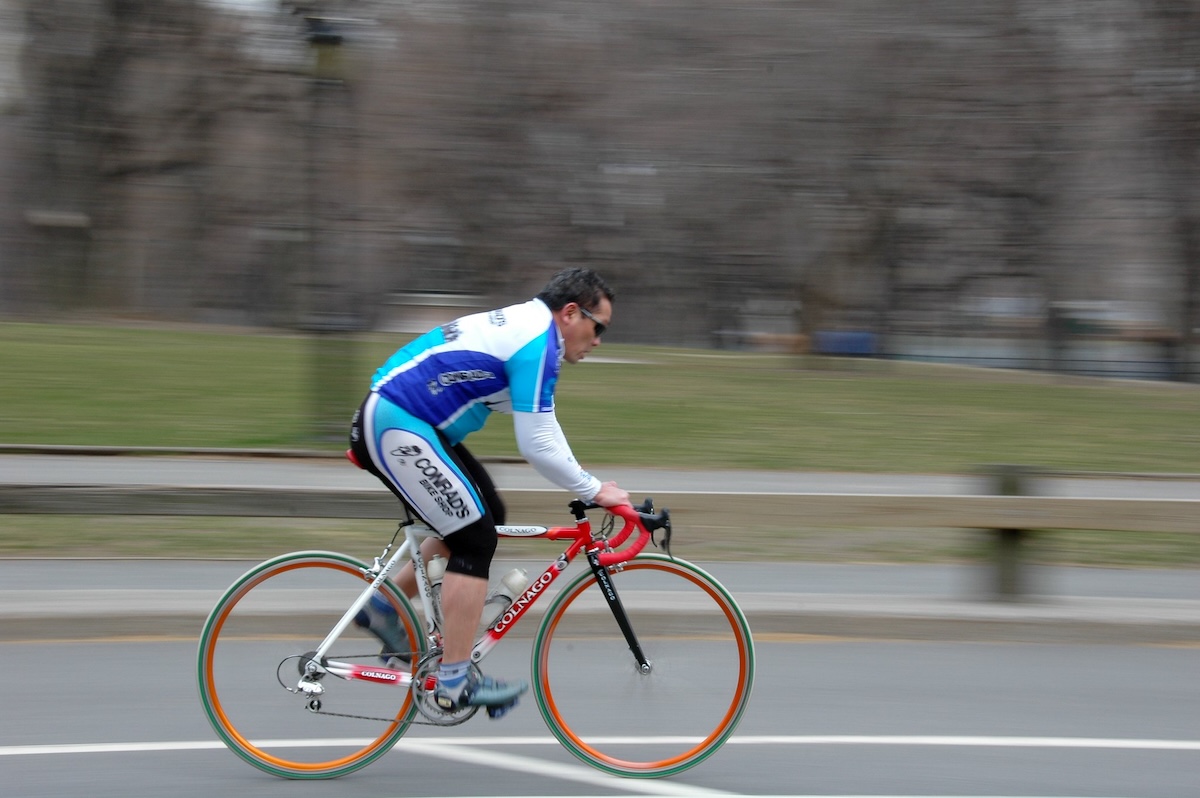
At the heart of the dispute is whether Central Park can continue to serve as a training ground for competitive cyclists. The park’s loop drives are widely considered the only infrastructure in Manhattan suitable for high-intensity cycling, and riders regularly exceed 15 mph during training — as did Olympian Kristen Faulkner before her gold medal performance at the 2024 Paris Games.
Two competitive cyclists submitted sworn declarations in support of the lawsuit. Sarah Chubb Sauvayre, who has ridden in the park for 42 years, wrote in her filing that race training requires riding at speed and that there is no way to build the necessary fitness without it. Colin Taber, the club’s president, warned that the speed limit would push cyclists out of the park and onto city streets — or force them to risk criminal summonses for training at the speeds their sport demands.
Advertisement
The club says its members already take safety seriously, following a “Central Park Protocol” that concentrates high-speed training rides during the least crowded hours of early morning and late evening. A January DOT report tracking average bike speeds in the park found that cyclists only exceed 15 mph on average before 9 a.m., according to Gothamist.The speed limit reduction was one of several cycling-related policies enacted in the final stretch of the Adams administration. Earlier actions included directing the NYPD to issue criminal summonses rather than traffic tickets to cyclists and implementing a blanket 15 mph e-bike speed limit citywide.
It remains unclear whether the new Central Park limit has been officially implemented. The DOT began a 60-day community board review period on Dec. 15, which has since expired, but the agency — now under Mayor Mamdani’s administration — has not confirmed the limit is in effect.
The DOT defended the policy in a statement, saying the speed limit “promotes safety” and “aligns with the speed limit for e-scooters and e-bikes on city streets,” calling it a measure to reduce confusion and keep the park comfortable for all users.
Betsy Smith, president and CEO of the Central Park Conservancy, backed the reduced limit when it was announced, writing that a clear, consistent speed limit helps reduce conflicts and makes the drives safer for everyone.
New York Cycle Club spokesman Neile Weissman, who is also known for advocating for better bike infrastructure on the George Washington Bridge, argued that the real solution lies not in speed limits or enforcement but in building more space for cyclists. He noted that roughly half of Central Park’s visitors arrive by bike, yet cyclists are allocated only about 10 percent of available paths — which they must share with pedestrians.
“The Central Park Conservancy is showing a lack of vision in not pushing forward with bikeways along the transverses and the adjacent avenues,” Weissman said. “This lack of imagination is the reason why everyone is so frustrated — the city is literally not thinking outside the park.”
Mayor Mamdani campaigned as a champion of cycling. Whether his administration will defend, modify, or abandon the speed limit policy it inherited may signal how seriously City Hall intends to follow through on those promises.
The New York Cycle Club has been leading group rides across the five boroughs since the 1930s.
Have a news tip? Send it to us here!