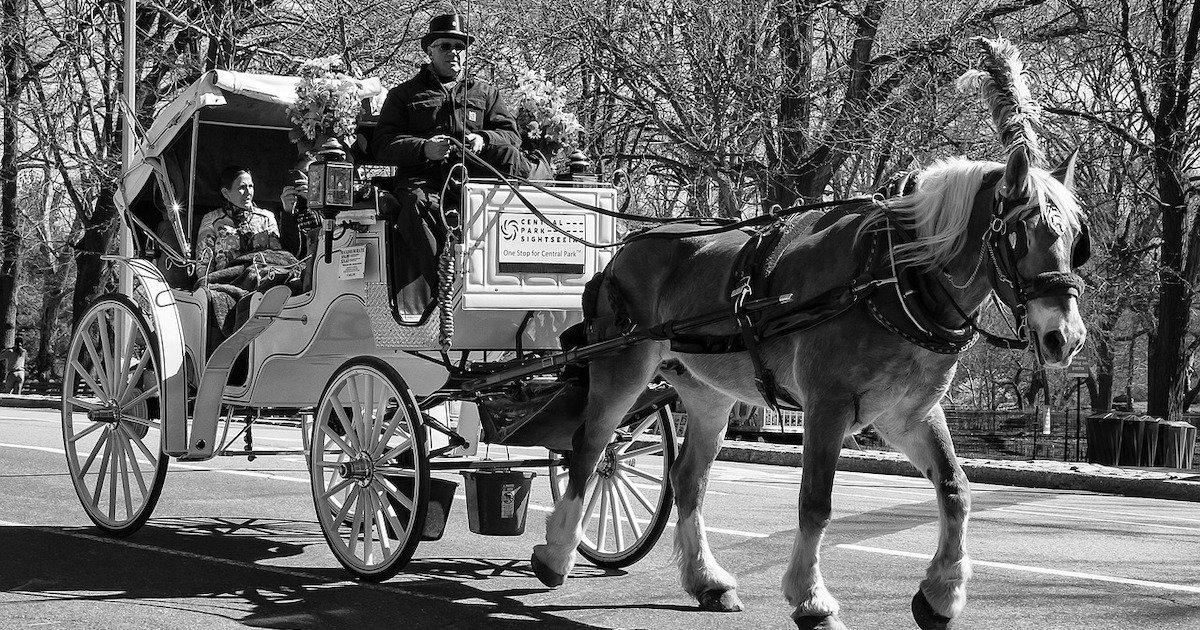
When a 16-year-old carriage horse collapsed and died in Central Park near West 72nd Street last Tuesday evening, the assumptions came fast: too old, too hot, too overworked. Animal rights groups and some elected officials said it was proof the carriage trade should be shut down for good. But a necropsy released this week tells a different story — one that has the horse’s union and the conservancy that runs Central Park pointing fingers squarely at each other.
Advertisement
The horse, named Deniz, reportedly died after eating a Japanese yew, a common ornamental shrub that is highly toxic to horses. The Transport Workers Union of America, which represents the city’s carriage drivers, said Deniz paused to nibble a shrub along the curb near East 90th Street on June 9 while pulling two passengers, then collapsed a short time later and was pronounced dead on the West Side of the park around 8 p.m.The necropsy, performed by Cornell University’s College of Veterinary Medicine, found abundant plant needles consistent with Japanese yew in his mouth, stomach and digestive tract, the union said in publicizing the report Tuesday. Yew contains compounds that can send a horse into cardiac arrest, and even small amounts can be fatal.
The union used the findings to push back against the renewed calls for a ban. Deniz’s death “was not caused by neglect or abuse or the fact he was a carriage horse,” said Alexander Kemp, its administrative vice president, who instead blamed the Central Park Conservancy for never warning that deadly yew shrubs were planted in the park.
The conservancy fired back. Spokesperson Kate Blumm noted that Japanese yew is planted widely across the U.S. and Canada, and that park rules forbid horses from grazing on any vegetation across the park’s 843 acres — rules that also require drivers to attend to their animals at all times. The conservancy argued the death pointed to the union’s own negligence, and reiterated its support for ending carriage rides altogether.
Advertisement
The fight lands amid a long-running push to abolish the carriage industry. A bill known as Ryder’s Law — named for a horse that collapsed on a Midtown street in 2022 — would phase out the trade entirely. Groups like PETA have protested the rides for years over traffic and heat, and the conservancy says it has logged seven carriage-horse incidents in the park’s vicinity over the past 13 months, including a January episode in which a horse bolted into traffic and struck cars. Deniz had passed a physical exam by the NYPD Mounted Unit’s veterinarian in March.Have a news tip? Send it to us here!