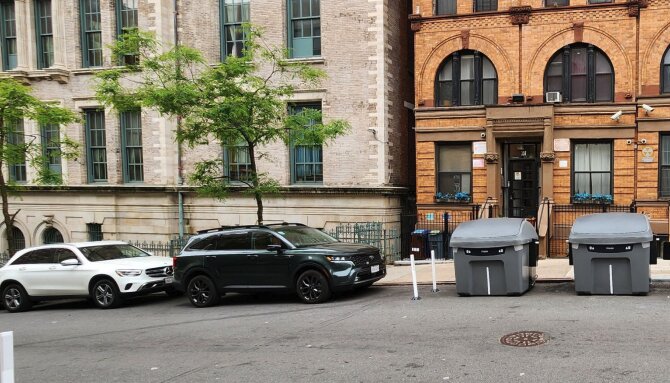
Department of Sanitation
The city has released the environmental study that will guide how its curbside trash-container program reshapes streets across New York over the next several years, and it puts a hard number on what it would mean for the Upper West Side. Among all 59 of the city’s community districts, the study projects that no neighborhood would see a larger share of its on-street parking reallocated to trash containers than the Upper West Side.
Advertisement
That projection comes from the Draft Environmental Impact Statement the Department of Sanitation published this month for its Citywide Containerization Program, the plan to move residential trash off the sidewalk and into European-style “Empire Bin” containers set in the parking lane. Running the numbers district by district, the agency projects that Manhattan Community District 7, which covers the Upper West Side, would lose 10.38 percent of its legal on-street parking — the single highest share in the city. The Upper East Side ranks second at 9.99 percent, and no other neighborhood in the five boroughs tops 8 percent.In concrete terms, the study counts 14,052 legal on-street parking spaces on the Upper West Side today. If the program is fully built out, roughly 1,460 of them would be occupied by as many as 3,211 containers. That figure is a ceiling rather than a certainty: the mandate applies only to buildings with 31 or more residential units, which account for about 2,193 bins and roughly 953 spaces on their own. Buildings with 10 to 30 units may choose whether to opt in or keep using wheeled bins on the sidewalk, so the realistic range runs from about 950 spaces on the low end to 1,460 if nearly every eligible building participates.
How much that matters to any given resident depends heavily on whether they drive. In Manhattan, only about one in five households owns a car — among the lowest rates in the country — and citywide most households own no vehicle at all, according to U.S. Census figures. Street parking is also a shared resource used by visitors, contractors, and delivery drivers, not only residents, which is part of why curb space remains contested even in a neighborhood where car ownership is low.
The city frames the program as a public-health and quality-of-life measure. Sanitation officials say containerizing trash removes the bags that pile up on sidewalks, cuts off a major food source for rats, and clears walking space for pedestrians. The agency has pointed to its first fully containerized district, West Harlem, where it has credited the bins with cleaner streets and reported a decline in traffic injuries after curbside parking gave way to containers. Critics counter that the city is trading scarce parking for the change and question how evenly the benefits and costs are distributed.
Advertisement
What the document does not say is where, exactly, the Upper West Side’s containers would go. The Sanitation Department’s detailed, block-by-block parking study did not examine the neighborhood — for its Manhattan case study, the agency used the Upper East Side and applied the results citywide. Specific placement here is left to a future “container siting assessment” the agency says it will conduct for each district before installation, in coordination with the city’s Transportation Department and building superintendents. The only placement rule the study commits to is that each bin sit in the parking lane “in front of or near” the building it serves, which means the containers would cluster on blocks with large apartment buildings rather than brownstone side streets.The timeline is also unset. The program is being phased in with a citywide target of June 1, 2032, and the only installation the city has scheduled next is in Brooklyn. The Upper West Side is not assigned a year in the document.
The citywide framing is already contested. The Sanitation Department now counts 1,959,761 legal parking spaces across the city — down from the roughly three million the Transportation Department used for years, after subtracting hydrants, loading zones, and other no-parking curb. Supporters note that the containers would take up barely 1.5 percent of that citywide total; on the Upper West Side, measured against the neighborhood’s own 14,052 spaces, the share is more than 10 percent.
The draft study is open for public comment before the city finalizes it, the window in which residents, building owners, and community boards on both sides of the question can weigh in. For a district that has spent years debating changes to neighborhood parking, the highest projected parking impact in the city is likely to draw comment.
Advertisement
Written comments will be accepted through 5:00 p.m. on August 7 by email to containerEIS@dsny.nyc.gov or by mail to Abas O. Braimah, DSNY Bureau of Legal Affairs, 125 Worth Street, Room 710, New York, NY 10013; mailed comments must be postmarked by that date. The Sanitation Department will also hold a public hearing on July 28 from 10:00 a.m. to 12:00 p.m. over Microsoft Teams, where residents can offer comments in person; the meeting can be joined by video (meeting ID 219 272 571 493 081, passcode Ga3j6mG2) or by phone at 646-893-7101, conference ID 166 758 25#. Anyone who needs interpreter services or another accommodation is asked to email the department at least 10 days in advance.Have a news tip? Send it to us here!