Google Maps
A pilot program that’s been tracking double-parked trucks and delivery vans on one of the Upper West Side’s busiest commercial blocks is wrapping up this week, and the city hasn’t said yet what the cameras found.
Advertisement
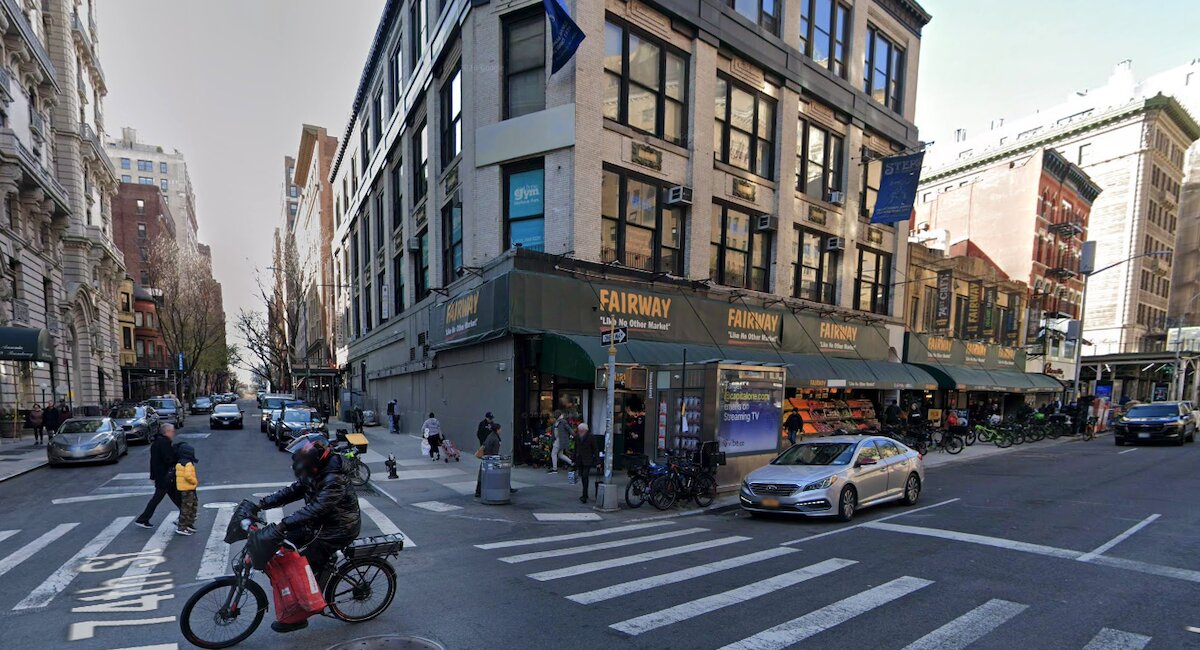
The cameras belong to Automotus, a curb-management technology company. They were installed as part of an NYC Department of Transportation test on Broadway between West 74th and West 75th streets, and on parts of West 74th Street between Broadway and West End Avenue. The company announced the pilot in an August 4 press release. At Tuesday night’s Community Board 7 Transportation Committee meeting, Kory Young of the company’s commercial team said the cameras are being removed this week.Young said the cameras actually went up earlier in the year. He said the August announcement took a while because it had to go through DOT’s approval process.
Margot Zuckerman, who works on strategy and growth at Automotus, said DOT picked the location because of its high rates of parking violations and commercial vehicles. She noted that Fairway sits at the corner. Young said the cameras focused on the truck loading zones at both spots. Zuckerman said they could also see three or four lanes of traffic, which let them count double- and even triple-parked vehicles.
According to the company’s announcement, the system gives DOT a real-time dashboard and historical data on parking occupancy, how long vehicles stay, illegal parking, double parking and overall traffic flow. Zuckerman said the cameras also record each vehicle’s make, model and color, and count passing cyclists and pedestrians without recording any details about them.
Nobody was charged or ticketed. Zuckerman said the New York test was data collection only. In other cities, the company runs what it calls “smart loading zones.” Cameras detect a vehicle when it pulls in, charge the driver by the minute, and flag overstays and double parking so an officer can review them and mail a ticket.
The results are still a mystery for now. When a committee member asked when the board would see the data, Young said that’s up to DOT, which is still reviewing the pilot’s findings. One committee member said she didn’t know the pilot was happening in the neighborhood until she saw a press release. She said she wants CB7 to be able to share the data with the community once it’s available.
Committee members also asked about privacy. Zuckerman said video is processed on the camera itself, and faces and unrelated license plates are blurred automatically. Young said only images tied to a parking event are sent back, and everything else is deleted, usually within 12 hours. He said that when the company has been subpoenaed in other cities, it had no data to hand over. He also said the city owns the data, and Automotus doesn’t resell it.
Advertisement
It isn’t the first time cameras on that block have raised privacy questions. In 2023, Fairway’s parent company, Wakefern, confirmed that its stores, including the Upper West Side Fairway, were using facial recognition technology. A company spokeswoman said at the time that it was aimed at repeat shoplifters. The Automotus pilot is a separate program, run as part of a DOT test.The committee chair asked whether a city could use the cameras to charge higher rates for oversized SUVs. Zuckerman said that’s theoretically possible, since the cameras already identify each vehicle’s make and model.
The company also pointed to results from other cities. Zuckerman said Philadelphia, which has Automotus smart loading zones on 52 blocks of Center City, saw a 97% increase in commercial vehicles using loading zones properly and about a 30% increase in rush-hour traffic speeds. She said a three-month pilot in Hoboken last year cut blocked bike lanes by 59% and blocked bus stops by 44%.
Closer to home, Automotus’s work hasn’t been without controversy. In June, Jersey City pulled a resolution awarding the company a camera-assisted parking enforcement contract after the city’s business administrator said an Automotus executive’s donation to the mayor and most council members hadn’t been properly disclosed, according to Hudson County View. The outlet found that CEO Jordan Justus had given $1,000 to a council slate led by James Solomon, now Jersey City’s mayor. The city started its bidding process over, and Zuckerberg told the committee Tuesday that Automotus won the contract this summer.
Have a news tip? Send it to us here!