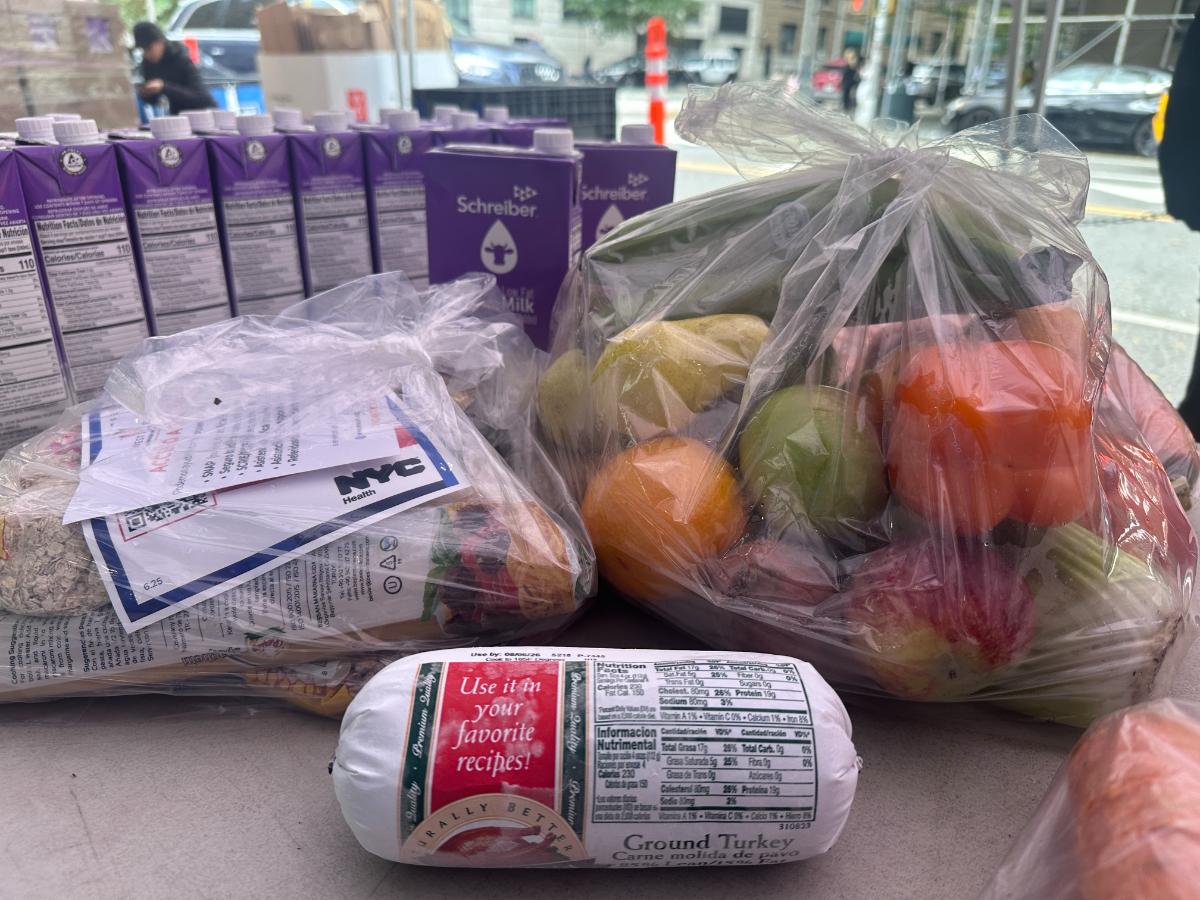
Fresh food being distributed at the West Side Campaign Against Hunger on Friday, October 31
Free Upper West Side News, Delivered To Your Inbox
With the government shutdown now in its second month, 42 million Americans — including 1.8 million in New York City, roughly 540,000 children and 540,000 older adults — are left wondering if they’ll be able to put food on the table, especially with the holiday season approaching. The shutdown, currently at 32 days, is the second-longest in U.S. history and just three days short of the 35-day record set in 2018-2019, both during President Donald Trump’s administration. Funding for SNAP in NYC totals $420 million a month. As of November 1, benefits for the next cycle have not yet been issued.
Advertisement
Key Developments- On Thursday, October 30, Governor Kathy Hochul declared a state of emergency for New York, pledging $65 million in new state funds to support food banks, soup kitchens, and other outlets. These funds supplement a $40 million investment in the Hunger Prevention and Nutrition Assistance Program (HPNAP), bringing total funding to $106 million, according to her office.
- Mayor Eric Adams’ office added $15 million in emergency funding to the Community Food Connection Program on October 30. A statement noted that New York City has already allocated $820 million to food programs for the 2025 fiscal year.
- A federal judge ruled that the Trump administration must continue to pay for SNAP during the government shutdown. It remains unclear if and when SNAP will be fully restored. Trump posted on Truth Social that funds would be released once they receive “appropriate legal direction” from the court, while warning that November benefits would “unfortunately be delayed.”
“The current administration is using food as a tool for political gain,” said Alyson Rosenthal, chief program officer at West Side Campaign Against Hunger (WSCAH), whose headquarters are at 263 West 86th Street inside St. Paul & St. Andrew United Methodist Church. “This is on the backs of working families, older adults, and children.”
Rosenthal noted she was not surprised by the judge’s Friday ruling to utilize the government’s contingency funding ($5-$6 billion) for SNAP, while emphasizing that it would require $8 billion to fund SNAP in full through November, in line with what has been reported. “Trump continues to find ways to delay the use of these funds and to then manipulate messaging as a political tool at the expense of working families, older adults, [and] children.” She called the matter a human rights issue, describing the administration’s handling of the situation as “deplorable,” and urged that the federal government release the funds as ordered by the judges.
As SNAP’s status remains in limbo, ILTUWS heard from Upper West Siders looking for ways to donate money or food to support local programs like WSCAH and others.
West Side Campaign Against Hunger (WSCAH) serves over 100,000 New Yorkers every month, with more than half of the food distributed on the Upper West Side. The organization also partners with over two dozen community-based groups across the city, primarily in upper Manhattan and the Bronx.
With SNAP benefits uncertain, WSCAH is increasing its food distribution by 50 percent this November to help families make it through the month. “We have families with young children who are going to have to make tough decisions about whether they’re purchasing formula or paying rent,” said Rosenthal. “People are panicking within the community, and there is no way that food pantries and food banks can fill the gap that SNAP fills.”
Advertisement
Rosenthal told us, “We can certainly use more help,” so for those looking to donate to a great cause, you can click here to make a cash donation — their number one need. Rosenthal noted that new SNAP rules beginning November 1, which include work requirements for able-bodied adults without dependents, are further complicating matters. “If people are not working or volunteering, they can lose benefits after three months,” she said.On Friday, October 31, ILTUWS visited WSCAH’s main distribution center on 86th Street with Isabela Colmenares, development and communications coordinator. Heart-healthy grains and proteins, including pasta and beans, as well as culturally sensitive items, are assembled in packs for visitors to pick up once a month, Tuesday through Friday, from 9 a.m. to 1 p.m. Some volunteers were dressed in Halloween costumes, helping lighten the mood as those in need collected their monthly allotment, which includes fresh produce. Colmenares noted that produce makes up roughly half of each pack. WSCAH also operates a newer 13,000-square-foot warehouse and distribution hub in Washington Heights.
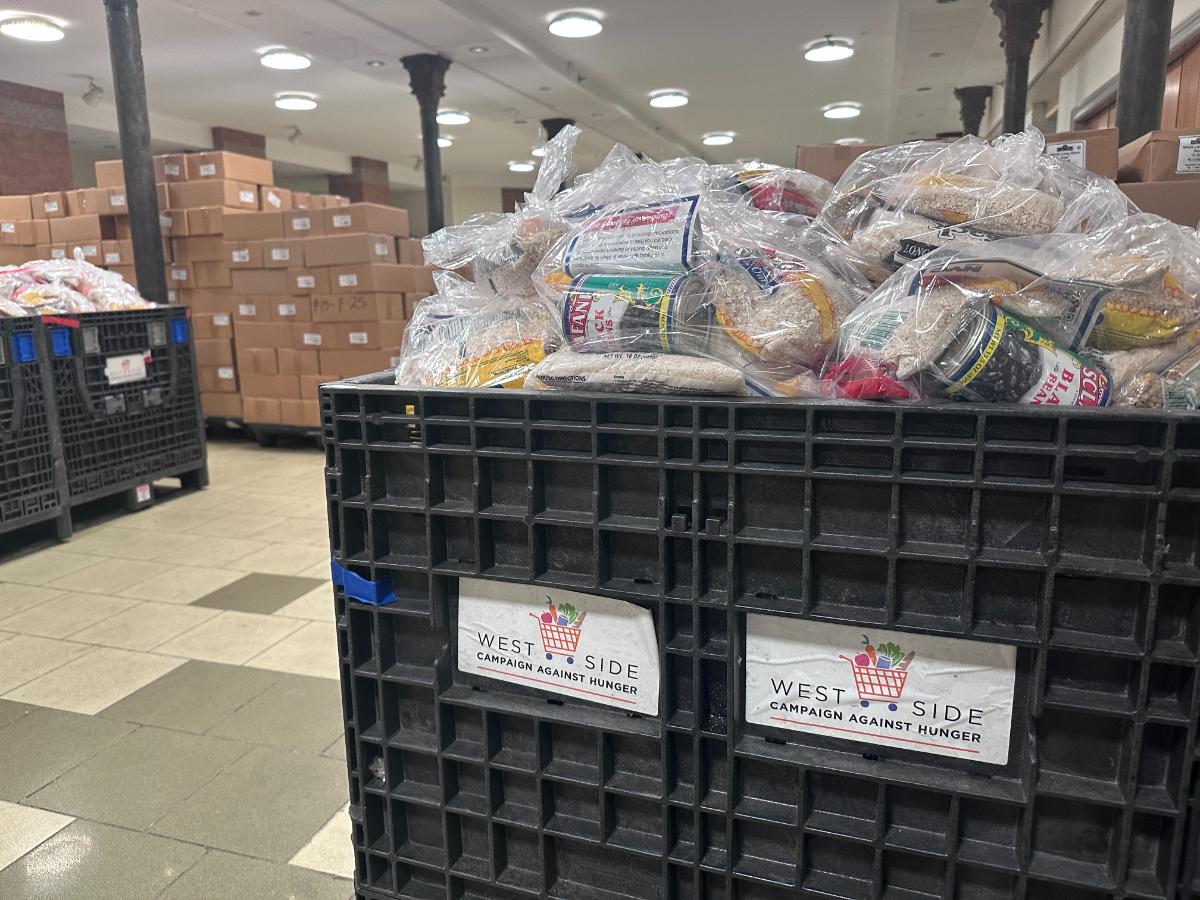
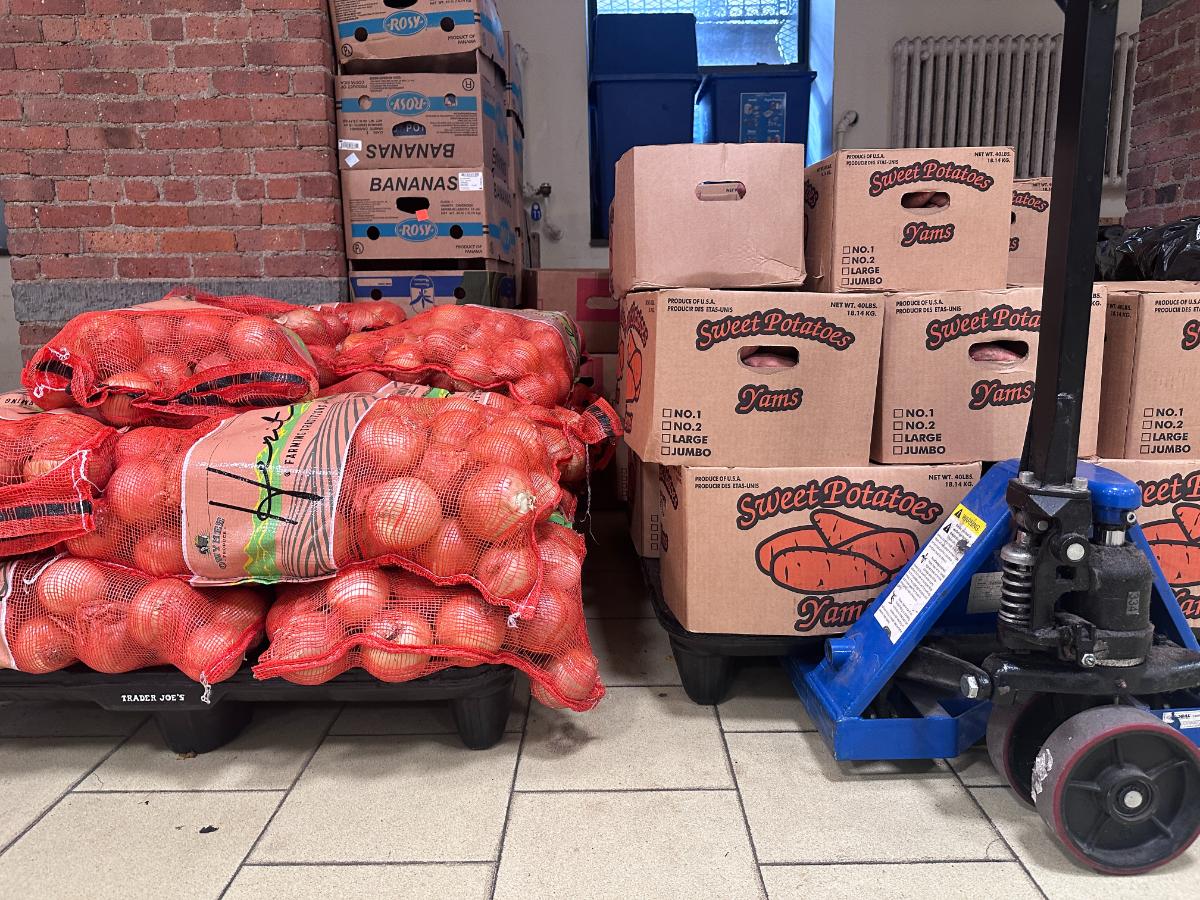
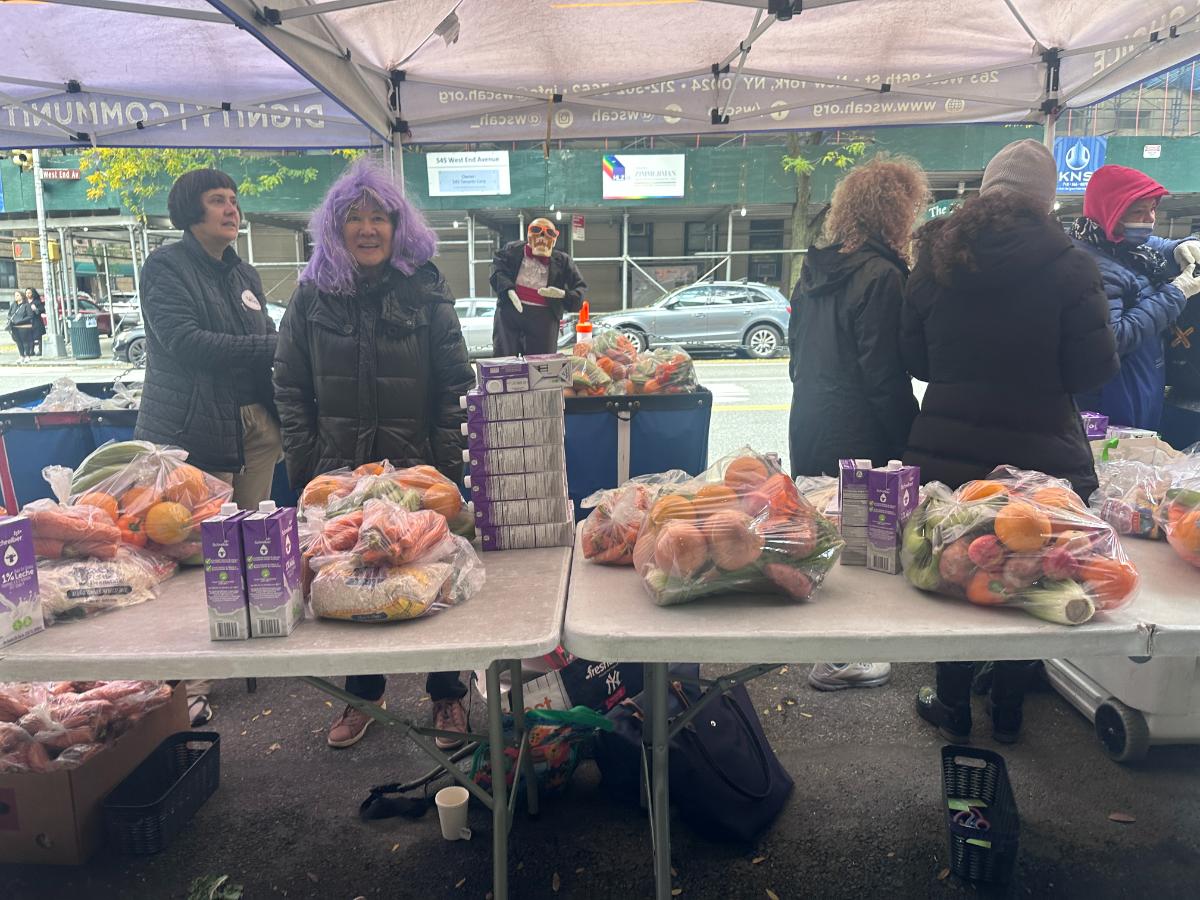
ILTUWS spoke with Tanisha, a first-time visitor to WSCAH who came by after hearing about potential SNAP cuts. “I don’t receive SNAP right now; I’m unemployed and my unemployment ran out,” said the 10023-area resident. “This food pantry is a huge help — it lets me make sure I still have good quality meals and offset some costs for food.”
Tanisha found the pantry through online postings and shared the resources with neighbors and friends. “It’s a relief to have this available,” she said, noting she’s also seen other pop-up food initiatives across the city. “But with all these cuts going to the top 1% while basic human needs are ignored, it’s alarming.”
She added that the situation feels like “an attack on humanity,” extending beyond politics to the effects of greed and policy decisions. Tanisha highlighted the strain on families with rising costs and job losses: “People are trying to resist the pressure, but with prices inflated and the holidays coming, it’s hard to provide for your family.”
Tanisha also spoke about her daughter, a college student with an activist mindset, who has been following these developments closely. “They see what’s happening in higher education, the anti-DEI efforts, and how resources are being cut,” Tanisha said. “It’s very concerning for them and their peers.”

Lucia, from the South Bronx, has been coming to WSCAH for about a year and welcomed the extra food being distributed in November. A current SNAP recipient, she expressed hope that benefits will continue and praised Governor Hochul for allocating emergency funds to support food programs.
WSCAH is also preparing for the holidays, distributing over 12,000 turkeys and pork shoulders to ensure families have a healthy Thanksgiving. WSCAH emphasizes that cash donations are the most effective way to help. “Unfortunately, there’s only so far that a couple cans of food can go,” Rosenthal said. “We really need people to donate dollars, and volunteers are always welcome.”
The organization also runs a mobile market and a fleet of branded box trucks that deliver pre-packed boxes of food to partner organizations and neighborhood-based food distributions. More than half of the food given out is fresh produce, and the group distributes over 5 million pounds of food annually.
“Without SNAP, we are going to see a crisis like we’ve never seen before,” Rosenthal said. She called for city, state, and federal officials to step in, stressing that nonprofit organizations alone cannot fill the safety net. “We hope to engage more Upper West Siders in this work so that, in partnership with the community, we can rise up and meet this hunger crisis.”
The Cathedral Church of St. John the Divine in Morningside Heights is also stepping up in response to the SNAP cuts amid the holiday season. A spokesperson for St. John the Divine told ILTUWS that its Cathedral Community Cares (CCC) program, which has been fighting poverty through preventative services, education, and advocacy for over 40 years, serves nearly 60,000 visits annually — roughly 36,000 of those for the food pantry and weekly hot meals. CCC supports unhoused individuals, low-income families, seniors, and migrants through four main programs: a weekly hot meal, a clothing closet, a food pantry/community fridge, and a weekly food pantry run through the Plentiful app.
In response to the potential loss of SNAP benefits, CCC will distribute $100 grocery gift cards so families and individuals can purchase food with dignity and choice. Donations directly support this effort. The program also collects monthly items to help New Yorkers in need, including hand and foot warmers in November, gift cards for holiday meals and gifts in December, hygiene products in January, hoodies in February, sneakers in March, and clothing items for its closet in April.
Reverend Winnie Varghese, the first woman to serve as dean of the world’s largest Gothic cathedral, and Thomas Perry, CCC’s program manager, highlighted these efforts in a recent Instagram video. For those looking to donate, the Cathedral has made it easy through this link.
Advertisement
Another key resource to keep handy is the Hunter College New York City Food Policy Center’s Food Resource Guide for the Upper West Side. One clutch option listed is Christ and St. Stephen’s Church at 120 West 69th Street between Columbus and Broadway. Their Brown Bag Program offers grab-and-go meals Monday through Friday from 9:30 a.m. to 10:30 a.m., with options including chunk chicken, tuna fish, mac and cheese, and more, along with a juice and a fruit. They are currently accepting non-perishable food items.Rutgers Thursday Nighters has long been a popular stop at 236 West 73rd Street between Broadway and West End Avenue, with lines often stretching down the block on Thursdays for their ham and cheese or turkey sandwiches. They typically serve the first 70 visitors, and it’s best to arrive early for the 6 p.m. start.
There’s also the Grand Central Food Program, which delivers roughly 1,000 hot, nutritious meals daily to homeless and hungry New Yorkers along a route that includes 79th Street and the Boat Basin (West Side Highway) at 7:55 p.m., West 86th and West End Avenue at 8:15 p.m., and the Cathedral of St. John the Divine at 112th and Amsterdam at 8:45 p.m. Popular options include meatballs and chicken, along with bagels, fruit, and a beverage, Monday through Friday.
ILTUWS — like many of you — is awaiting word from the Trump Administration on the future of SNAP for 42 million Americans. The programs above are working to fill the gap, but if benefits are cut, the pressure on local food resources will grow quickly and significantly.
Have a news tip? Send it to us here!