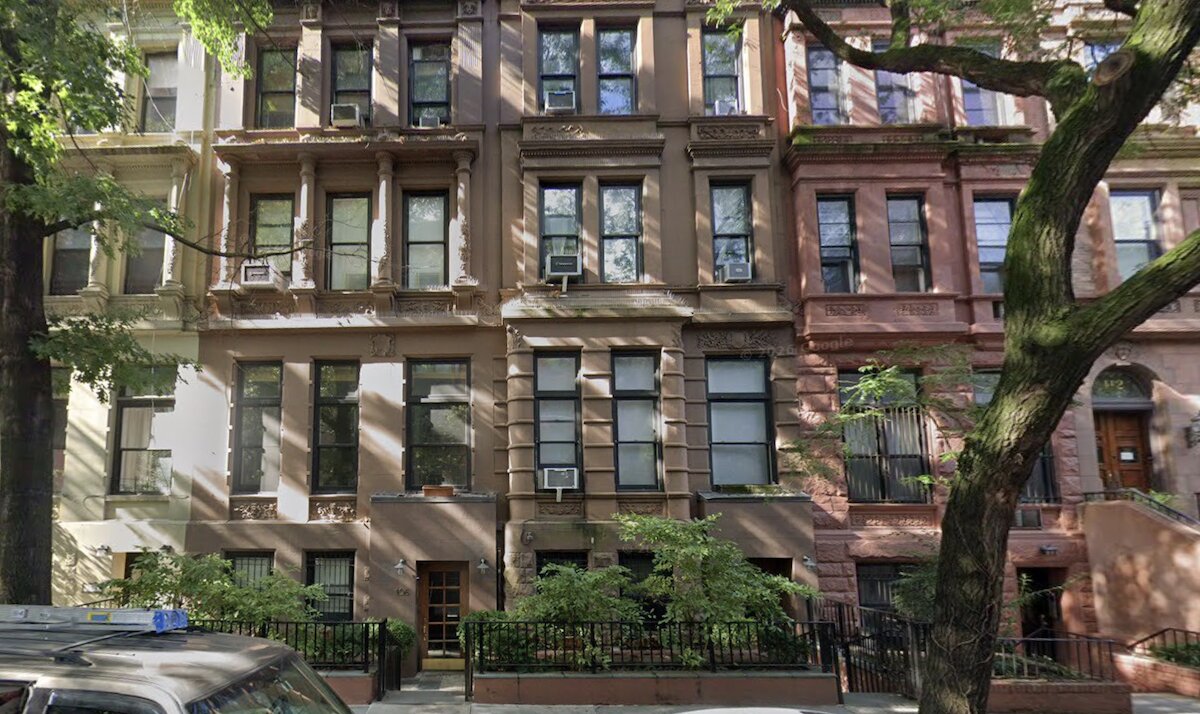
Google Maps
The UWS co-op bought the studio back from him last year for around $400,000. He hasn’t lived there since 2017. And on Aug. 19, both sides are due back in court again — over a toilet.
Advertisement
Gary Paul, 72, is nine years into a lawsuit against his former Upper West Side co-op at 108 West 87th Street, its management company and the neighbors who lived directly above him, according to the New York Post. The demand started at $650,000, was amended upward to $750,000, and his attorney, Ian Brandt, now argues the whole thing is worth more than a million dollars once legal fees, lost rental value and destroyed belongings are counted. Brandt puts it plainly: what should have been a $50,000 to $80,000 repair has metastasized into a $700,000-plus damages claim.ALSO READ: UWS Condo Board Suing to Force Out Resident Who Allegedly Threatened to Kill Two People
The co-op board president, Michael Laba, has a blunter word for it. Paul, he says, has been a nightmare — a former board member of roughly two decades who was voted off nearly 18 years ago and has been hunting for a reason to sue ever since. Brandt says that’s nonsense, and that his client is simply a man who lost his home.
What both sides agree on is that a hose came loose from a toilet.
Paul says he was sitting in his first-floor bathroom on a Sunday in June 2017 when brown grit began running down the mirror. The crown molding above him was splitting. Inside the walls, he could hear water moving. It had come from unit 2A, directly overhead, and it kept coming — into his kitchen, out into the hallway where it stood an inch deep, and eventually down into the basement.
His central allegation is about the clock. Management, he claims, treated a Sunday flood as a Monday problem, and water ran for more than 18 hours before anyone showed up with keys — with a plumber arriving hours after that to finally stop it. Thousands of gallons, by his account, before anyone turned a valve.
Advertisement
Then came the itemized wreckage. Hand-printed Morris & Co. wallpaper in the foyer, which Paul valued at $13,000 to replace in 2017 dollars. A 19th-century claret jug designed by Christopher Dresser, listed in court records at $2,340. Water pooling around the electrical panel, he says, and then inside it. He stopped paying his $581 monthly maintenance, and the suit followed — filed, he says, because nobody would hand over insurance money or remediate the mold.Laba’s account inverts nearly all of it. He says management responded appropriately and that Paul is the one who blocked the fix, refusing to let anyone in to dry the unit out on the grounds of severe dust allergies. Laba alleges Paul was hoping mold would take hold, and that he pulled out his own stove, tub and drywall to make the place look ruined. The building eventually re-outfitted the apartment anyway — after which, Laba says, Paul buried city agencies in complaints about missing smoke detectors, a defective electrical panel and unfinished work. Some of those complaints produced violations, city records show. Paul calls himself a stickler for rules and says the filings were the only way to force movement.
The board minutes are not kind to him. A November 2017 entry labels him a constantly disgruntled shareholder, the Post reports. By February 2018, the board’s language had hardened to “incessantly combative,” and noted he had sent the managing agent something like 290 emails, described as consistently adversarial.
Here’s the part that stings. When Paul ran the board himself, the co-op got sued by a shareholder who found mold during a renovation and said the building never finished pulling out the affected sheetrock. The building’s defense at the time? That she wouldn’t grant the access needed to complete the job — which is, almost verbatim, the argument now being aimed at him.
Paul bought the 400-square-foot studio in the late 1980s for about $100,000, roughly $300,000 in today’s market. He describes it fondly, like a small English hotel room — cheap, easy, a place to leave and come back to between travels. He’s been bouncing between rentals ever since the flood.
Advertisement
The board countersued him for the unpaid maintenance and settled by purchasing the apartment out from under the dispute in 2025. One of the upstairs owners referred questions to her insurance carrier. That unit’s insurance defense attorney summed the saga up as silly, given that it all traces back to one water leak. The management company’s attorney didn’t respond to the Post.The next court date is August 19.
Have a news tip? Send it to us here!