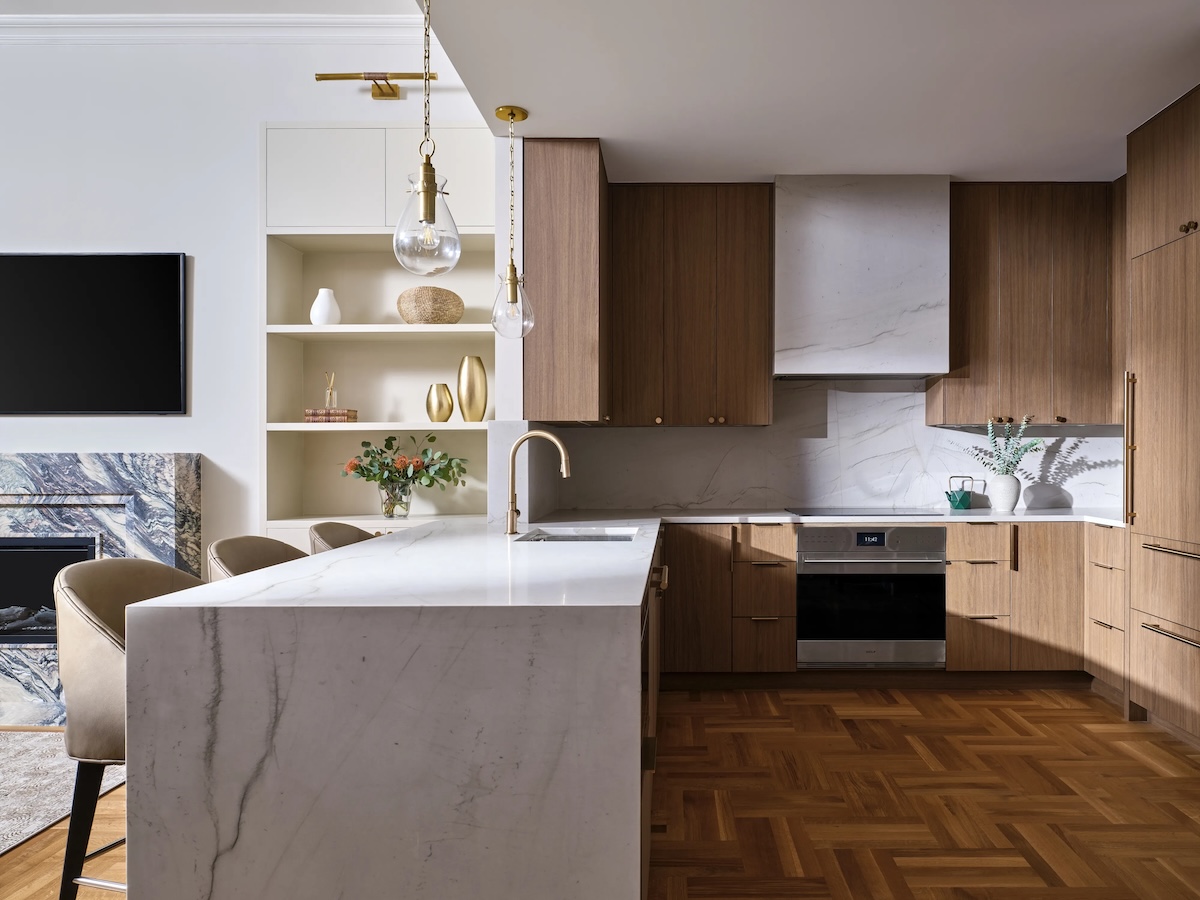
A post-renovation look at one of Gallery KBNY’s recent UWS projects. Photo: Kyle Caldwell
The Upper West Side holds some of Manhattan’s most sought-after pre-war stock, from Classic 6, 7, and 8 layouts along Central Park West and West End Avenue to postwar towers like Lincoln Towers and newer condos along Riverside Boulevard. That variety is part of the appeal, and it also means no two purchases carry the same renovation math. Before an offer goes in on a UWS co-op, a handful of checks can save months of delay and a meaningful amount of budget. We asked Avi Zikry, founder of the Manhattan design-build firm Gallery KBNY, to walk us through the seven worth understanding before you sign.
1. Pull the Alteration Agreement Before You’re Under Contract
UWS co-op boards are among the most detailed and demanding in the city, and the alteration agreement is where that shows up first. Expect requirements around board-approved architects, insurance requirements, and limits on renovation timelines just as the baseline. “On some Central Park West buildings, it runs $5,000/day in penalties for going over the allotted timeline for the renovation,” says Avi Zikry, president of Gallery KBNY.
2. Ask About the Building’s Electrical Capacity
Most UWS co-ops were built long before the electrical demands of modern kitchens and central air conditioning. “Beyond bringing the existing electrical systems up to code, it’s important to understand how much electrical capacity the apartment currently has, whether a service upgrade is necessary, and, just as importantly, whether the building has the infrastructure to support it,” Zikry explains. “Electrical service upgrades can cost $40,000 or more as part of a full gut renovation, so it’s one of the first things we evaluate before putting together a budget.” An initial conversation with the building superintendent or management, followed by an electrical load assessment when necessary, can help identify potential limitations and costs early enough to plan accordingly.
3. Get a Real Asbestos Read
Plaster walls and original pipe insulation are common across the Upper West Side’s pre-war stock, and both frequently contain asbestos. “Testing is inexpensive relative to the alternative,” Zikry says. “Abatement runs $10,000 to $50,000 or more when asbestos turns up, and knowing early lets a design plan work around it from the start.”
4. Understand the Board Approval Timeline Before You Pick a Move-In Date
Alteration agreement review and board approval on the UWS typically take 60 to 120 days, and pre-war buildings on Central Park West and West End Avenue tend to run toward the longer end. “Layer design and permitting on top, and a full renovation realistically spans 10 to 16 months from consultation to move-in,” Zikry says. Building that into the purchase timeline now avoids a painful surprise later.
5. Look Past the Floor Plan and Into the Walls
A floor plan shows rooms, not what’s inside the walls. “Structural columns, gas risers, and plumbing stacks rarely appear on paper,” Zikry says. “Finding one mid-demolition is one of the more common reasons a renovation stalls or a budget grows.” A brief walkthrough with someone who knows what to look for surfaces these conditions well before they become change orders.
6. Price the “Estate Condition” Apartment Like the Renovation It Actually Is
“An unrenovated Classic 7 with original details can end up costing nearly as much to bring current as one that’s simply dated,” Zikry says. “Both typically need the same wiring, plumbing, and plaster work behind the walls.” Character and condition are different questions, and pricing them as the same one is where budgets go sideways.
7. Why This Usually Ends Up Being One Team’s Job
In practice, very few buyers run all six of these checks themselves, and it’s not for lack of trying. Between a due-diligence window that’s already tight and the specialized knowledge each item calls for (an electrician for the load test, a certified tester for asbestos, someone who has read enough alteration agreements to know what a particular board will flag), coordinating it all alone is a real undertaking on top of everything else a home purchase already involves.
“That gap is exactly why we started offering a pre-purchase assessment,” Zikry says. “One walkthrough, and we can turn these six unknowns into a written scope, cost range, and timeline while a buyer can still close with clear eyes.” Gallery KBNY offers the assessment at no charge while a buyer is under contract.
The Upper West Side rewards patience more than almost any other Manhattan neighborhood. Its boards are thorough, and its buildings are old enough to have real stories behind the walls, which is exactly why a closer look before signing tends to be worth the time it takes.
Gallery KBNY is a full-service design-build firm based in Manhattan, recognized with 100+ five-star reviews and seven consecutive years of Houzz Best of Design and Service awards. For buyers under contract on a UWS co-op or condo, we’d point you toward the pre-purchase assessment Zikry described.