c/o The Leopard at des Artistes
Free Upper West Side News, Delivered To Your Inbox
The Leopard at Des Artistes, the elegant Southern Italian restaurant that has graced the ground floor of the historic Hotel des Artistes since 2011, will serve its final meal on Sunday, February 15.
Advertisement
“It is time to say goodbye,” the restaurant announced on Instagram on Monday. “What an incredible journey it has been! THANK YOU!!!! We invite you to join us at The Leopard throughout the next few days and weeks, before we serve our last meal.”The closure marks the end of an era not just for the restaurant, but for a dining space that has been feeding Upper West Siders for over a century, through multiple incarnations, two world wars, recessions, and a pandemic.
The Hotel des Artistes at 1 West 67th Street is no ordinary address. Designed by architect George Mort Pollard and completed in 1917, the Gothic-style building was conceived as an artists’ cooperative, the largest “studio” building in New York City. Its distinctive façade features gargoyles depicting painters, sculptors, and writers, and its apartments were designed with soaring double-height windows to provide artists with ample natural light for their work.
But here’s the thing about artists’ studios: they didn’t have kitchens. The building’s developers understood that creative types needed to eat, so they included a communal restaurant on the ground floor. What began as a practical solution for feeding residents became one of New York’s most storied dining rooms.
The building’s residents over the decades read like a Who’s Who of American culture: dancer Isadora Duncan, playwright Noël Coward, painter Norman Rockwell, writer Fannie Hurst, film star Rudolph Valentino, actress Fanny Brice, choreographer George Balanchine, and New York City Mayor John V. Lindsay all called it home.
The dining room’s most distinctive feature came courtesy of one of the building’s most famous residents: Howard Chandler Christy. The illustrator, known for his “Christy Girl” images and patriotic WWI recruitment posters, lived and worked in the Hotel des Artistes from 1917 until his death in 1952.
Advertisement
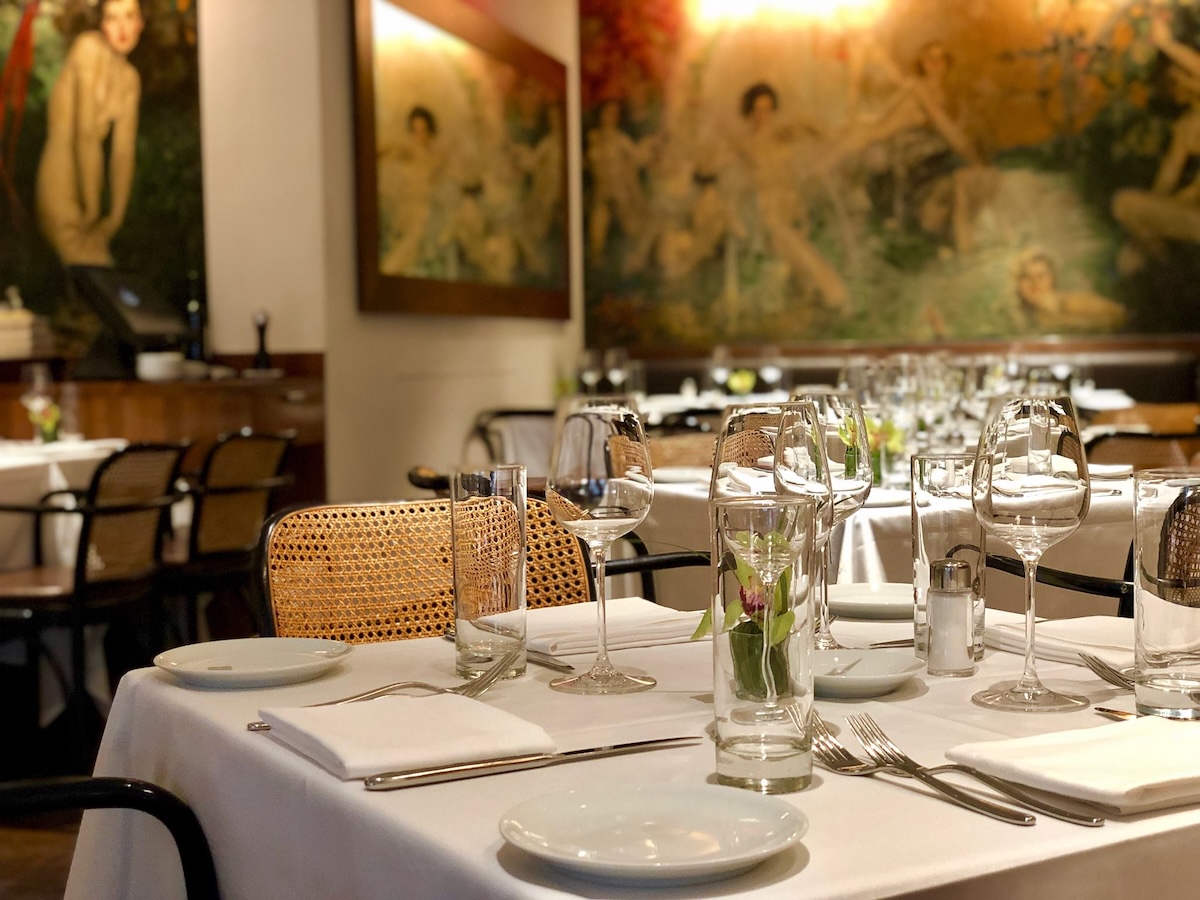
In 1934, during the depths of the Depression, Christy painted the murals that would become synonymous with the restaurant: “Fantasy Scenes with Naked Beauties,” a series of nine panels depicting wood nymphs frolicking in pastoral settings. The murals, completed by 1935, transformed the dining room into something magical—a bit risqué for the era, entirely appropriate for a bohemian artists’ colony.There’s a wonderful story about those murals: a client once brought his 102-year-old mother to celebrate her birthday and specifically requested to sit beneath one of the paintings. The reason? She claimed to be the young woman depicted lying in the grass.
Christy’s works—including panels titled “The Swing Girl,” “The Parrot Girl,” “Fountain of Youth,” and others—remain on the walls today, restored and preserved, having witnessed nearly a century of meals, celebrations, proposals, and goodbyes.
By the mid-1970s, the original Café des Artistes had fallen on hard times. Enter George Lang, a Hungarian-born restaurateur with an extraordinary life story. Lang had escaped a forced-labor camp during World War II (both his parents died at Auschwitz), fled to Austria hidden in a coffin, and arrived in New York in 1946 with little more than dreams of becoming a concert violinist.
After attending a concert by the great Jascha Heifetz, Lang realized he would never achieve such heights as a musician and pivoted to restaurants. He worked his way up through New York’s culinary world, eventually becoming director of the legendary Four Seasons before starting his own consulting firm.
In 1975, David Garth, a board member of Hotel des Artistes, approached Lang about taking over the struggling ground-floor restaurant. In his memoir, Lang described it as “a dark, dingy little place that was empty most of the time.”
Advertisement
Lang saw potential. He cleaned Christy’s murals, renovated the interior, and let light into the dining room. He created a menu of updated bistro and trattoria dishes and transformed Café des Artistes into one of New York’s most romantic dining destinations. For more than three decades under Lang’s stewardship, the restaurant became a favorite of performers from nearby Lincoln Center, Upper West Side literati, and anyone seeking an Old World atmosphere that felt genuinely, rather than affectedly, European.But the Great Recession proved too much. In August 2009, Lang closed Café des Artistes and filed for bankruptcy protection. He died in 2011, just as a new chapter was beginning at 1 West 67th Street.
Gianfranco Sorrentino, a Naples-born restaurateur who had already established the acclaimed Il Gattopardo near MoMA with his wife Paula Bolla-Sorrentino, saw an opportunity to breathe new life into the beloved space. In May 2011, he and Paula reopened the restaurant as The Leopard at Des Artistes.
The name was no accident: both Il Gattopardo and The Leopard reference Luchino Visconti’s 1963 film “The Leopard” (Il Gattopardo in Italian), starring Burt Lancaster. And like the film’s meditation on change and continuity, the Sorrentinos sought to honor the past while creating something new.
They restored the space to its 1920s glory, cleaned and preserved Christy’s murals, and introduced a menu rooted in Southern Italian traditions—specifically, the cuisine of the former “Kingdom of the Two Sicilies” and the regions of Campania, Basilicata, Calabria, Apulia, and Sardinia.
Gianfranco Sorrentino brought more than 45 years of experience in restaurant management, from the Quisisana Hotel in Capri to the Dorchester in London to the Four Seasons in Tokyo. He was also deeply committed to promoting Italian culinary culture, serving as president of Gruppo Italiano, a nonprofit organization that awarded scholarships to culinary students and organized educational tours to Italian wineries and cheesemakers.
Advertisement
For 15 years, The Leopard became a neighborhood go-to for special occasions: anniversaries, birthdays, pre-opera dinners, and post-concert celebrations. The live jazz brunch on weekends became an institution. Chef Jordan Frosolone, who joined in 2020, brought his passion for regional Italian cooking to a menu featuring dishes like Lasagne Ennese, Orata Ripieno, and one of the finest Bistecca alla Fiorentina in the city. Manager George Coteanu’s tableside Zabaglione became legendary.Tragically, Gianfranco Sorrentino passed away in November 2024 after months of illness, leaving behind Paula and their children, Sofia and Edoardo, to carry on his legacy.
With the February 15 closure, the question becomes: what happens next for this irreplaceable space?
The Christy murals, which have been designated as New York City landmarks, will presumably remain. The Hotel des Artistes itself isn’t going anywhere—it’s protected as part of the West 67th Street Artists’ Colony Historic District on the National Register of Historic Places.
But restaurants are ephemeral by nature. What made Café des Artistes and then The Leopard special wasn’t just the murals or the Gothic architecture or the history. It was the feeling of continuity, of participating in something larger than a single meal—the knowledge that you were sitting where Isadora Duncan once sat, eating beneath paintings by an artist who lived upstairs, in a room that had served the neighborhood for generations.
For Upper West Siders who want one last meal at The Leopard, the restaurant will remain open through February 15. Reservations are recommended—this is a goodbye many will want to say in person.
And for those who have never been? There are still a few days left to experience a dining room that Marcel Duchamp, Norman Rockwell, and generations of New Yorkers have enjoyed before you.
Have a news tip? Send it to us here!